Hormuz: Everything Is Bottoming Except the Crisis
Chinese Imports, Oil Inventories, Investor Sentiment, and Prices

July 2026 may well be the turning point for Hormuz. For nearly five months, one of the largest oil-supply disruptions in modern history has produced remarkably little reward for energy bulls. China withdrew from the international crude market. Governments drained strategic reserves. Commercial inventories absorbed the shock. Traders became increasingly bearish, and oil prices fell back toward levels last seen when the market still believed the Strait would reopen quickly. Those forces merely postponed the consequences; they did not resolve the crisis.
Now, several of the pressures that suppressed prices appear to be approaching their limits at the same time. Chinese seaborne imports are near decade lows and below most estimates of a sustainable operating level. The United States is nearing the practical limits of its Strategic Petroleum Reserve. Product inventories are increasingly strained. My proprietary measure of oil-market sentiment has rebounded from its most bearish levels of the war. Oil prices remain depressed relative to the scale and duration of the disruption. Everything may be bottoming except the crisis itself.
The Strait remains severely restricted. Millions of barrels per day of production remain offline. Inbound tanker traffic has not normalized. Repeated diplomatic agreements have failed to produce a durable reopening. The conflict may now also be expanding toward the Red Sea corridor that has allowed Saudi Arabia to partially bypass Hormuz.
Understanding why requires looking beyond inventories, tanker counts, and negotiating headlines. Those factors determine how the trade expresses itself, but they do not explain why the Strait remains closed or why every reopening has collapsed.
My thesis has always rested on three deeper forces:
Iran’s mosaic defense system may have dispersed operational control beyond the reach of its diplomats.
Mojtaba Khamenei may be the only person capable of reasserting that control, and everything we know about his circumstances and behavior points toward revenge rather than restraint.
The closure is an attempt to establish deterrence by inflicting enough economic and political pain that the United States and Israel never attack Iran again.
I laid out that argument in March and April. Four months later, the thesis is unchanged. What has changed is the strength of the evidence behind it. Over the past week, all three parts of the thesis have surfaced more clearly than at any previous point in the war.
Oil Sentiment May Have Already Bottomed
One of the more subjective parts of this trade has always been sentiment. Oil bulls have spent nearly five months watching one of the largest supply disruptions in modern history produce falling prices, failed breakouts, expiring options, and repeated declarations that the crisis was over.
By late June, the mood among even the most committed oil bulls had become extraordinarily bearish. Many were cutting positions or leaving the trade entirely. That was the kind of capitulation I had been waiting for before rebuilding my own exposure.
My approach to the trade has also changed substantially over the past two months. I cut my CVE position roughly in half and moved part of that capital to Hyperliquid, allowing me to express the thesis more directly through front-month crude prices rather than almost entirely through one Canadian producer. I view the Hyperliquid approach to be a far cleaner approach for both getting leverage and actually following crude price movements than anything I was able to do with USO or BNO calls, for example.
The sentiment reversal helped me time that shift. As the index described below reached its lows and began to recover, I started scaling back into oil through Brent and WTI perpetual futures. I am still below my previous peak exposure but I have been adding over the past two weeks including today (July 13th).
Measured against portfolio equity, my current gross oil exposure is roughly 60% CVE shares and options, 35% Brent perpetuals, and 15% WTI perpetuals. The detailed transactions are included in the position ledger near the end of the article, but the important change is that the trade is now split between producer exposure and direct crude exposure with a stronger lean towards Brent perpetuals due to the concern that Trump will almost certainly threaten an export ban when WTI gets too high (even though the export ban wouldn’t actually help anything).
I wanted to measure the broader sentiment shift more systematically, so I built the Hyperforage Oil Sentiment Index, or HOSI. It tracks roughly 50 oil-focused Twitter accounts and scores their posts based on whether they are expressing a more bullish or bearish crude-price outlook than usual.
Many of these accounts are structurally bullish, so simply counting bullish posts would not tell us much. HOSI measures each account relative to its own historical behavior, then combines those scores into hourly and daily sentiment readings.
The result is the magenta line below, plotted against front-month CL prices.
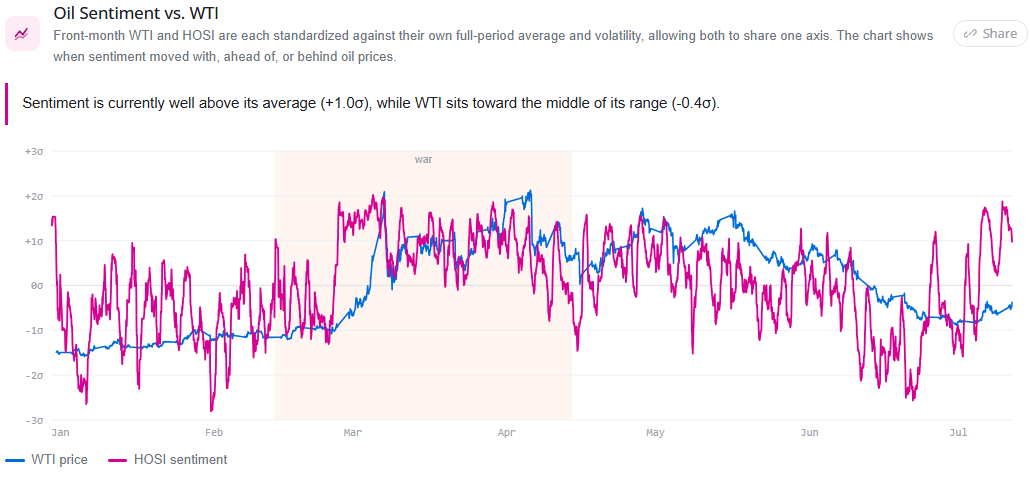
The index suggests that oil sentiment reached its most bearish levels of the war in late June before rebounding sharply. The June 23–28 recovery was the largest positive sentiment swing of the year. The July 6–8 move was nearly as large and occurred at roughly twice the normal level of attention.
I would not claim that HOSI predicts oil prices. Most of the time, sentiment moves with or shortly after crude. Its value is that it quantifies capitulation, conviction, and the size of each narrative repricing instead of forcing me to describe Oil Twitter’s mood by feel.
In this case, it gave me something actionable. The most bearish phase among the oil bulls I follow appears to have passed, and I have begun rebuilding exposure accordingly.
The full interactive dashboard includes account-level sentiment, attention data, daily and weekly readings, and a catalog of the largest sentiment swings of the war.
Explore the Hyperforage Oil Sentiment Index here.
Mosaic Defense Becomes Visible
Iran’s defense system was built to survive decapitation. Under its “mosaic defense” model, 32 regional commanders received wartime instructions before the February 28 strikes and retained broad autonomy over attack decisions. On March 1, Foreign Minister Abbas Araghchi described the units controlling the Strait as isolated and operating under instructions issued in advance.
That created a problem no diplomatic agreement can solve on its own. Tehran may promise, and even desire, to reopen the Strait, but the promise is meaningless unless the armed units controlling the water obey it.
The Islamabad Memorandum of Understanding was heavily favorable to Iran, but it contained one unusually clear concession. Article 5 required 60 days of toll-free passage through the Strait.
The agreement was signed in mid-June. By June 22, two routes had effectively crystallized: an Iranian-controlled route and an Omani route. The IRGC objected to the volume of traffic avoiding the Iranian channel and spent the following ten days attacking ships attempting to use non-Iranian routes.
On July 8, Israel Hayom reported that Araghchi had told Steve Witkoff and Jared Kushner that he could not guarantee the IRGC would stop firing on ships and tankers:
Trump’s decision to launch the strike came after envoys Steve Witkoff and Jared Kushner reported that the Iranian negotiating partner, Foreign Minister Abbas Araghchi, had said he could not guarantee that the Islamic Revolutionary Guard Corps would not continue firing on ships and tankers crossing the Strait of Hormuz.
The report said the IRGC had chosen to “break the rules” by continuing to require ships to report, receive approval, and pay for passage, which directly contradicted the memorandum’s toll-free provision. Two days later, CBS and Reuters reported that Iranian officials had privately blamed the attacks on an “errant” group of hardliners attempting to undermine the negotiations.
This is the mosaic defense thesis playing out in real time. Iran’s diplomats, by their own admission, appear unable to guarantee that the forces controlling the Strait will honor terms they have already accepted.
Mojtaba’s Answer Was Revenge
If anyone has the authority to bring these “errant” IRGC factions under control, it is Supreme Leader Mojtaba Khamenei. Nothing about his position suggests he is inclined to do so.
He was already considered more hardline than his father and is now operating through an existential war, serious reported injuries, and the deaths of his father, wife, sister, niece, and brother-in-law. Any authority consolidating around him is likely to be less calibrated, less predictable, and more consumed by revenge.
On July 10, the United States gave Iran 24 hours to publicly acknowledge that the attacks on commercial ships were a mistake, promise that they would stop, and declare every channel through the Strait open and toll-free. They warned that failure to comply would bring “harsh consequences.”
At roughly the same time, Israel warned Trump that Iran was developing another assassination plot against him. Trump responded by declaring that 1,000 missiles were aimed at Iran, with thousands more ready to follow if the threat were carried out.
Hours later, Mojtaba followed up with language that was anything but conciliatory.


The United States was looking for a public rebuke of the commanders attacking ships, instructions to honor the memorandum, and some indication that Iran’s leadership was preparing the country, or its military, for compromise. Instead, Iran’s most powerful political and military figure threatened Trump’s life and warned that the people responsible for his father’s death would not die peacefully.
This was the clearest display of Mojtaba’s actual state of mind since he became Ayatollah. The person most capable of forcing the Strait open appears to have little interest in doing so.
The Objective Is Deterrence
In my view, establishing deterrence is Iran’s primary objective. Its leaders have watched the country’s command structure get decapitated. Roughly half of its ten most powerful positions have experienced “turnover” twice in the past year. Anyone holding one of those jobs today has to assume that he and his family could be next.
Iran needs to make another American or Israeli attack prohibitively costly.
There are only a few ways to do that: obtain nuclear weapons, or keep Hormuz closed long enough to drain oil inventories, send prices sharply higher, and inflict visible economic and political damage on the President of the United States. Assassinating Trump would also establish deterrence, though I consider that outcome extremely unlikely.
Critically, neither a nuclear breakout nor the weaponization of Hormuz requires Iran to be actively engaged in a war. Both require time.
This is perhaps the number one thing much of the prevailing analysis gets wrong, in my opinion. The MoU and the subsequent lull are treated as evidence that Washington and Tehran have reached some kind of fragile understanding. I see another possibility: Iran is using the pause to outlast the world’s oil buffers.
The absence of war does not interrupt the strategy. It may actually be the preferred state when the objective is to run global inventories down without absorbing another round of massive attacks.
Iran obviously cannot keep the Strait closed forever. The closure cuts into its own oil revenue, tightens the blockade, strains its ability to finance the IRGC and supply the civilian population, and accelerates investment in routes that bypass Hormuz.
They are therefore racing two clocks. They need to keep the Strait closed long enough to impose unmistakable costs on the United States, but not so long that the strategy threatens the regime itself.
The midterm elections in November are one possible way to impose a political cost. I believe that is probably part of Iran’s calculus. However, it is worth noting that the only people I have seen discuss Iran targeting Trump through the midterms are Americans and marginal Iranians who do not appear especially close to the core of the military leadership. As far as I know, Mojtaba, Araghchi, Ghalibaf, and Vahidi have not referenced the elections in any meaningful way.
The central question throughout every negotiation has remained the same: does Iran believe it has inflicted enough pain to establish real deterrence?
In my view, until the answer is yes, a durable reopening remains unlikely.
Deep Dive: Conditions Have Never Been Better
My oil positions have reduced my portfolio’s year-to-date gain from 44% to 20%. Much of what I initially made has been given back. While that is obviously frustrating, the underlying conditions are clearly moving in the bullish direction. The supply disruption has persisted, inventories have been depleted across much of the world, and the single largest source of bearish pressure, China’s extraordinary withdrawal from the international crude market, appears increasingly difficult to sustain.
There are still meaningful timing risks. China may remain on the sidelines longer than expected, and its eventual return will almost certainly be price-sensitive. Hormuz could reopen before inventories become binding. OPEC+ production could rise faster than demand recovers.
China is perhaps the biggest wild card and is therefore worth a deeper look.
China, the Gigantic Swing Buyer
China is the world’s second-largest oil consumer and its largest importer.
Before the war, China was importing roughly 11.4 million barrels per day in total, including approximately 10.5 million barrels per day by sea. By June, seaborne arrivals had fallen to roughly 6.5 million barrels per day, according to tanker-tracking estimates—the lowest level in a decade.
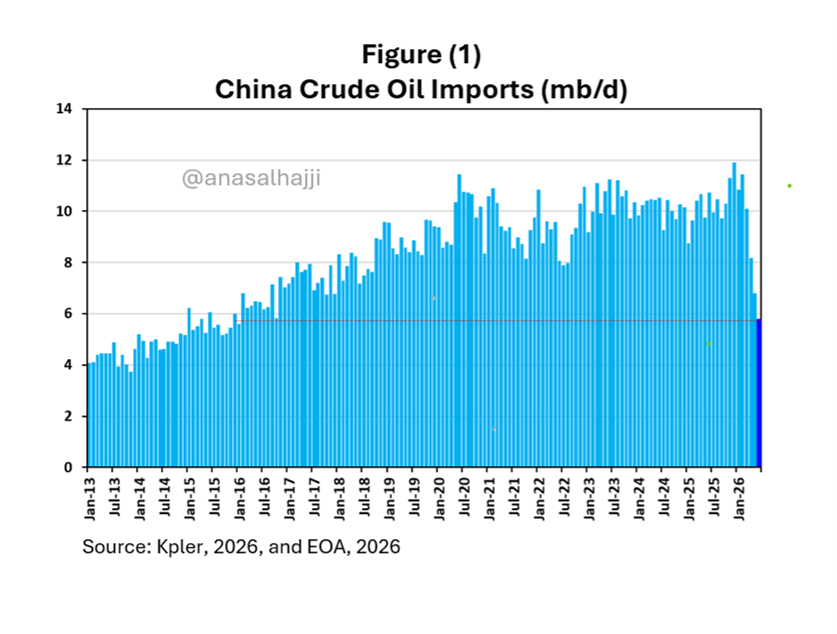
The exact numbers vary by dataset and comparison period. Estimates of the decline range from four million to six million barrels per day. They removed an amount of buying roughly equivalent to the combined oil consumption of Germany, France, and the United Kingdom. That explains the otherwise baffling oil price action.
The world suffered an enormous supply disruption, yet oil prices fell because its largest buyer simultaneously stopped buying. According to JPMorgan estimates cited widely across the oil market, China accounted for roughly 74% of the decline in global oil imports.
The Supply Disruption Did Not Disappear
The obvious bearish counterargument is that supply could normalize before China meaningfully returns. After the MoU was signed in June, roughly 80 million barrels of cargo that had been stranded inside the Gulf subsequently departed. OPEC+ has raised production quotas and crude inventories outside the United States increased in June. However, those developments have not restored anything close to normal physical supply.
As of July 11, estimates still placed approximately six million barrels per day of production offline—comparable in scale to the supply loss during the Arab oil embargo. Hormuz exports averaged only around 5.8 million barrels per day in June, while overall traffic through the Strait has continued to run at roughly one-fifth to one-third of pre-war levels. Tankers have continued to be attacked and inbound traffic remains minimal.
The mass departure of previously stranded cargo is not the same as a production recovery. Producers inside the Gulf need empty tankers arriving to load new crude. Without a sustained return of inbound very large crude carriers, production shut-ins and outward shipments cannot normalize. The market is therefore facing potential renewed Chinese buying while millions of barrels per day of production remain unavailable.
China Did Not Eliminate Four to Six Million Barrels of Consumption
A crucial distinction is between imports and underlying demand. China did reduce actual oil consumption. Estimates across the market generally suggest roughly one million to two million barrels per day of genuine demand response, driven by lower refinery activity and substitution from electric vehicles, coal, electrification, and coal-to-chemicals. Some of that reduction is structural and may never return.
However, it explains only a fraction of the import collapse. Imports fell much faster than refinery runs while refinery runs fell faster than end-user activity. Flights, trucking, road congestion, and much of the broader economy continued operating at levels inconsistent with a four- to six-million-barrel-per-day collapse in consumption.
The rest of the gap was covered through a combination of state-directed measures:
China stopped adding aggressively to inventories after roughly two years of stockpiling.
It drew oil held in domestic storage, including inventories controlled by state-owned companies.
Refiners cut throughput and shifted yields toward essential gasoline and diesel at the expense of petrochemical feedstocks.
Beijing restricted refined-product exports, retaining more fuel inside China.
State-owned refiners absorbed losses that commercially operated refiners would not normally tolerate.
Electric vehicles, coal-fired power, and coal-to-chemicals reduced the amount of crude required at the margin.
China entered the crisis with an estimated 1.2 billion barrels or more across commercial and strategic storage. It had also spent two years accumulating discounted Russian and Iranian crude. When prices rose and supply became uncertain, Beijing stopped filling the pantry and began eating from it.
Those inventories functioned like temporary new supply. The barrels never appeared in global production figures but they allowed Chinese refiners and consumers to operate without competing for seaborne cargoes. That was the central reason oil prices failed to respond as expected.
Why June Was Probably Not Sustainable
China’s strategy is powerful, yet impermanent. The Oxford Institute for Energy Studies estimated that a roughly 5% reduction in refinery runs could lower sustainable seaborne imports toward eight million barrels per day without inflicting severe economic damage. A 10% reduction could push the figure toward 7.2 million, but only by heavily sacrificing petrochemical production and relying on continued inventory support.
June arrivals of roughly 6.5 million barrels per day fell below even that stressed-case operating level. That does not mean imports cannot fall further temporarily. China could conceivably draw inventories much more aggressively. Some estimates suggest its buffers could allow it to reduce or even halt imports for months if Beijing were determined to wait out producers and force prices lower.
China can push imports almost arbitrarily low for a limited period by consuming inventories. It cannot maintain those levels indefinitely without depleting its security buffer, starving refineries of feedstock, or doing much more visible damage to domestic industry.
The asymmetry is therefore not that Chinese imports literally cannot decline further. It is that imports are already far below their likely sustainable level. The lower they go today, the more barrels must eventually be purchased or permanently removed from consumption tomorrow.
The Turn May Already Be Beginning
JPMorgan reportedly expects Chinese seaborne imports to recover to approximately nine million barrels per day by September and 10.5 million by year-end.
There are also tentative indications that the inflection may already have started:
Chinese independent refiners have returned for discounted Middle Eastern crude.
Improved refined-product export economics are increasing the need for additional feedstock.
Oil prices have returned toward the range in which China previously accumulated inventories.
Recent tanker and market commentary indicates that Chinese crude imports began picking up again in early July.
None of this guarantees a straight-line recovery. Citi has questioned whether China needs to return aggressively at all, arguing that refinery cuts, substitution, and belt-tightening can continue. Another plausible scenario is that Beijing deliberately remains absent until prices fall further, using its inventories to pressure producers before refilling at a better price.
China may be able to hurt oil bulls even further before it helps them. However, the June import rate is unlikely to represent a stable long-term equilibrium. A recovery from 6.5 million barrels per day toward nine million would return approximately 2.5 million barrels per day of buying to the physical market. A return toward 10.5 million would add roughly four million. China does not need to recover the entire four- to six-million-barrel reduction for the global balance to tighten materially.
Why China’s Return Might Not Cause an Immediate Price Explosion
China is unlikely to buy without regard to price. Beijing accumulated heavily when crude was cheap and withdrew when prices rose. Its return could therefore establish a floor under the market without immediately producing an uncontrolled spike. As prices increase, China may slow purchases or release more inventories.
Under normal circumstances, that would limit the upside. However, these are not normal circumstances. The United States’ Strategic Petroleum Reserve has fallen to roughly 319.5 million barrels, its lowest level since 1983, after approximately 172 million barrels were released during the crisis. Many of those barrels will eventually need to be repurchased.
Global onshore inventories reportedly declined by approximately 306 million barrels despite China reducing its imports by around 320 million barrels and governments undertaking the largest coordinated reserve release in history. Cushing has approached operationally dangerous levels. Japan recently recorded the largest crude-inventory draw in its history, while India is reportedly considering expanding its strategic reserve capacity roughly tenfold to more than 300 million barrels.
Some of that represents replacement demand. India’s proposed expansion would represent entirely new structural demand.
Crude inventories outside the United States did rise in June. Yet, one monthly increase does not reverse the broader depletion of the buffers that allowed the world to absorb the initial supply shock. China would not be returning to a well-supplied market. It would be returning after months of production losses, strategic reserve releases, commercial inventory draws, and severely restricted traffic through one of the world’s most important oil corridors.
The bullish case therefore does not require China to panic-buy or restore every barrel it removed. It requires only that China stop offsetting the supply shock with ever-larger import reductions.
The market fell because two enormous forces collided: the record-breaking loss of crude supply and the disappearance of its largest marginal buyer. For several months, China’s retreat appeared to be the stronger force. That retreat now appears close to its sustainable limits. The supply disruption remains. Global buffers are finite. China’s inventories are finite. And China does not need to become aggressively bullish for the balance to change. It merely needs to stop becoming more bearish.
The Great American Drain
The United States has used extraordinary inventory releases to prevent the supply shock from becoming a price shock. Those inventories are now approaching meaningful operational and political limits.
The Strategic Petroleum Reserve fell to 319.5 million barrels in the week ending July 3, down 95.9 million barrels, or 23%, in fifteen weeks. Approximately 36.5 million barrels of previously awarded sales have yet to be delivered, closely matching the International Energy Agency’s estimate that another 37 million barrels of finalized loans will flow through August regardless of market conditions.
Unless those commitments are changed, the SPR will soon fall to approximately 283 million barrels.
Nobody outside the government, and possibly inside the government, knows precisely where the reserve becomes operationally constrained.
The statutory threshold is approximately 252 million barrels, while estimates of the physical tank bottom extend as low as 180 million. Technical analyses of cavern-pressure requirements, along with former energy adviser Amos Hochstein’s estimate of an approximately 300-million-barrel floor, suggest that rapid extraction may become increasingly difficult somewhere between 275 million and 300 million barrels.
The math changes dramatically depending on which threshold is correct. Relative to a 300-million-barrel operational floor, the reserve has only about 19 million barrels of cushion today, and existing commitments alone would carry it below that level. Relative to 275 million barrels, only about eight million would remain after the committed sales. Even measured against the statutory 252-million-barrel threshold, the post-commitment cushion would be approximately 31 million barrels, roughly five weeks of releases at the recent pace.
The relevant question is not how many barrels theoretically remain underground. It is how quickly they can be withdrawn, what condition they are in, and how much the government is willing to release without compromising its ability to respond to another emergency.
We are already seeing reasons for caution. Refiners have reportedly complained that some delivered SPR crude contained hydrogen-sulfide concentrations far above normal safety standards. Energy Secretary Chris Wright has previously said that the rapid 2022 withdrawals damaged parts of the reserve’s infrastructure.
These reports do not establish a precise operational floor, but they reinforce the possibility that the headline inventory number overstates the quantity of crude that can be withdrawn quickly, safely, and cleanly.
Commercial Inventories Are Sending Mixed Signals
Commercial crude inventories are not falling in a straight line. They rose by approximately three million barrels in the latest weekly report, the first increase in eleven weeks.
Observed global inventories also increased by 21 million barrels in June, the first rise in four months. However, that increase largely reflected more oil in transit after the tanker backlog cleared, while onshore tanks continued drawing. Total OECD inventories fell by approximately 62 million barrels during the month, including 44 million barrels of government releases, although some OECD inventories outside the United States showed signs of rebuilding.
Those data points support the mainstream bearish case.
Goldman Sachs, Morgan Stanley, JPMorgan, and HSBC reportedly expect Hormuz exports to normalize between late July and the third quarter, potentially turning the current deficit into a surplus of one million to three million barrels per day. If that normalization occurs, today’s inventory pressure may prove temporary.
Cushing also recorded a small late-June increase. That may simply have been a bearish inventory build, as some analysts argued. Another interpretation is that barrels were redirected into the hub to preserve minimum operating capacity while inventories declined elsewhere.
The evidence is not decisive, but Cushing remains unusually depleted regardless of the explanation for a single weekly move.
The Futures Market and Refined Products
The futures market has not fully reflected the inventory stress. Managed-money short positioning reportedly exceeds 40%, described by one market analyst as the third-highest level in fifteen years. The precise denominator was not specified, but the broader point is that speculative positioning remains unusually bearish.
At the same time, the normal relationship between low Cushing inventories and stronger near-term WTI spreads has weakened.
One interpretation is that positioning and expectations of future supply normalization are outweighing current physical tightness. The paper market is effectively betting that the shortage will resolve before depleted inventories become binding. That may prove correct, but the clearest signs of stress are appearing downstream rather than in headline crude inventories.
Distillate stocks are near four-year lows. Gasoline inventories are near their lowest seasonal levels since 2012. There is no meaningful strategic reserve of gasoline or heating oil available to bridge a product shortage.
Meanwhile, global markets have lost refined-product exports that would ordinarily leave the Persian Gulf, pulling record volumes of American gasoline, diesel, and jet fuel overseas.
This is not being driven by booming US consumption. Four-week average gasoline demand is running near nine million barrels per day, its weakest reading for this period since 2022.
The product squeeze is instead being created by constrained foreign refining supply, unusually strong export demand, low starting inventories, and China’s decision to retain more fuel inside its own market.
Refining margins have become extreme. The 3-2-1 crack spread climbed from approximately $58 per barrel on July 3 to roughly $65 by July 8 and 9. At times, the value of converting crude into gasoline and diesel has approached the entire price of the crude itself.
That is a huge divergence between relatively calm crude futures and the products consumers actually use.
The Red Sea Tail Risk
The latest re-escalation has also created a new risk: the Hormuz crisis may be placing pressure on the corridor Saudi Arabia uses to bypass it.
Repeated Iranian flights into Houthi-controlled Yemen have reopened one of the main disputes behind the unresolved Saudi-Houthi peace process: whether Tehran can establish a direct air corridor to Sanaa without Saudi or Yemeni-government approval.
After strikes hit Sanaa’s runway on July 13, the Houthis declared that their period of de-escalation with Saudi Arabia was over and promised retaliation.
Neither of the recent vessel incidents in the southern Red Sea and Gulf of Aden has been attributed to the Houthis. There has also not yet been a confirmed campaign against Saudi territory or Saudi energy infrastructure.
For now, this remains a tail risk.
However, it is an important one. With Hormuz restricted, Saudi Arabia’s East-West pipeline and Red Sea export system have become one of the global oil market’s most important remaining pressure valves. The system can move approximately seven million barrels per day toward the Red Sea, with roughly five million barrels per day potentially available for export after supplying domestic refineries.
The world can partially bypass Hormuz by moving Saudi crude westward. It has no equivalent workaround if the East-West pipeline, Yanbu, Saudi refineries, or the Red Sea shipping corridor become part of the war.
The next meaningful signal is not another Houthi statement about Bab al-Mandab. It is whether the Houthis retaliate against Saudi territory, Saudi-linked shipping, or the infrastructure that currently allows the world to bypass Hormuz.
I will look at that risk in greater depth separately.
Position Ledger
Here’s a detailed look at how my portfolio has changed in recent months.
Late April and May
Continued buying out-of-the-money Cenovus calls while allowing several large April/May positions to expire worthless.
Bought American Airlines put options; the position remains open.
Took profits on legacy USO calls, then opened smaller USO and BNO call positions.
Early June
Added full downside protection through Cenovus puts and exited the hedge at a profit on June 10.
Mid-June
Sold half of my Cenovus shares at a profit
Sold July $27 covered calls against the remaining CVE position.
Opened a position in FTAI Aviation.
Late June/July
Exercised June $20 CVE calls—originally purchased in January and February—partially backfilling the shares sold earlier in June.
Began rebuilding upside oil exposure by buying back the short July $27 calls and adding August and September CVE calls with strikes ranging from $31 to $39.
Opened CL and Brent perpetual futures positions on Hyperliquid.
Net Effect
CVE reduced from 40% of portfolio to ~22%.
FTAI increased from 0% to 7%.
CL and Brent perpetual futures increased from 0% to 13%. (Refer back to the sentiment section at the top for a more precise breakdown of CL and Brent perpetuals).